Intelligence Analysis
El Niño 2026-2027: Global Weather, Supply Chain, and Infrastructure Risks
25 JUN 2026
/
10 min read

Impacts of El Niño on Global Weather Patterns
During the Northern Hemisphere summer, June-August, El Niño commonly affects climate patterns in the following ways:
- Warm and dry conditions over Central America, far northern South America, and the Caribbean
- Dry conditions across India, Papua New Guinea, and northern, central, and eastern Australia, as well as Maritime Southeast Asia
- Cool and dry conditions over far northeastern Australia and northern New Zealand, as well as parts of Melanesia and Polynesia
- Warm conditions in northwestern, west-central, and east-central South America
- Wet conditions over central Chile and west-central Argentina
The overall pattern is less pronounced globally compared to the winter months, with fewer regions showing strong anomalies.
During the Northern Hemisphere winter from December to February, El Niño commonly affects climate patterns in the following ways:
- Warm and dry conditions in southeastern Africa and Maritime Southeast Asia
- Warm conditions across northern North America, Mainland Southeast Asia, East Asia, South Asia, and east-central South America, as well as southeastern Australia
- Wet conditions in central East Africa and east-central South America, as well as Taiwan, eastern mainland China, southern US, and northern Mexico
- Cool and wet conditions in southern US
- Warm and wet conditions across the tropical Pacific extending into South America (Ecuador and northern Peru)
- Dry conditions stretch across the central Pacific, northern Oceania, and Maritime Southeast Asia
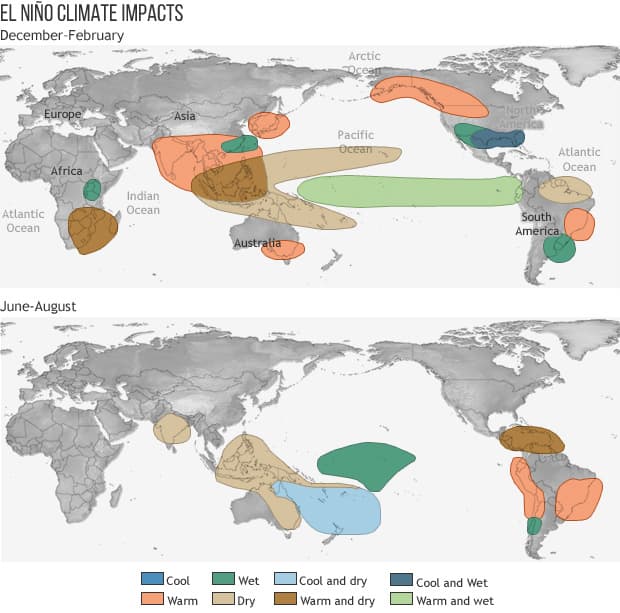
Image source: NOAA Climate.gov, Global impacts of El Niño and La Niña
Global and Regional Risks Linked to El Niño
The complex interplay among various atmospheric phenomena makes El Niño’s impacts difficult to predict. However, it has been linked to crop failures, increased wildfire risk, increased flood risk, heightened concurrent drought frequency, and disruptions to fisheries globally. Key associated trends include:
- Increased rainfall and flooding risk in East Africa, central Asia, northern Mexico, the southern US, Peru, and Ecuador
- Elevated fire risk in Indonesia, Australia, and the Amazon
- Drought conditions in India, southern Africa, the Philippines, Indonesia, Australia, and southern China, as well as the Amazon
- Warm conditions in Canada and the northern US
- Increased likelihood of tropical storm activity in the Pacific and less in the Atlantic
Among these regions, Latin America typically feels the most pronounced impact due to its proximity to the warmer waters of the Pacific; severe drought and heat in northern South America and parts of the Andean and Amazonian highlands areas, and enhanced rainfall and flood risk along the Pacific coast of Ecuador and Peru and across the La Plata Basin (northern Argentina, Paraguay, Uruguay, southern Brazil) in the southeast. Drought conditions reduce river levels, increase forest fire risk, and result in agricultural and livestock losses through lost pasture and water scarcity. Hydropower-dependent Andean states could see recurring generation shortfalls during droughts, forcing greater use of expensive gas-fired thermal generation, driving up power prices. Increased rainfall could lead to significant flooding and landslides, especially in Ecuador and Peru, resulting in fatalities, severe infrastructure damage, and transport disruptions. Increased flooding and standing water can also contribute to mosquito-borne disease outbreaks.
El Niño could lead to more high-tide flooding in parts of the US. Elevated sea levels along the west coast of the US can occur, causing high tides and strong surf to ride higher and push much further inland than normal. Along the Atlantic coast, the shift in the jet stream often steers storms towards the mid-Atlantic, resulting in more storm surge events. Higher than normal rain can also occur across the southern US, while the Pacific Northwest and Northern Rockies typically experience warmer and drier weather, which can worsen drought and increase the likelihood of large wildfires.
El Niño generally suppresses the southwest monsoon from May to September, impacting South Asia and Southeast Asia. Although El Niño lowers the seasonal average, it does not eliminate heavy rain events. Thus, flooding and landslides during heavy rainfall remain a risk. For South Asia, forecast models indicate that rainfall is likely to be below normal across most of the region, with the central regions most affected. For Southeast Asia, the dry season is likely to be longer and have an earlier onset. Reduced rainfall and drier conditions are also likely to lead to drought stress and water shortages. Above-normal temperatures, both maximum daytime and minimum overnight temperatures, are likely to elevate the risk of wildfires, especially in Sumatra and Kalimantan in Indonesia, where dry peat soils ignite easily. Transboundary haze is also a risk when extensive wildfires spread.
Possible Impacts on Manufacturing and Supply Chain Operations
As agriculture is highly sensitive to temperature and rainfall, these climate shifts translate into significant and uneven impacts on global crop production. In areas that experience unusually hot and dry conditions, including parts of Africa, Australia, Colombia, South Asia, and Southeast Asia, agricultural yields are likely to be significantly affected. By contrast, some regions, such as parts of the Americas, may see positive yield impacts, as conditions become wetter or more favorable. These effects vary by crop: globally, El Niño tends to reduce yields of maize, rice, and wheat, while soybean yields often increase, driven by gains in major producing regions such as the US and Brazil.
Crop shortages could have knock-on effects on food prices and supply chains, leading to inflation and other economic issues that could place added pressure on governments. Globally, there is a heightened risk of a shock to global food supply chains; wheat, rice, maize, and soybeans provide more than 60 percent of the world’s calorie intake. Maize and rice are especially sensitive to El Niño, with drought and disrupted monsoons reducing yields in major producers such as South Africa, India, Indonesia, Vietnam, and Brazil. Wheat is affected by heat and drought in key exporters like Australia, Canada, and China.
More extreme weather could worsen geopolitical tensions. Rising temperatures reduce crop fertility, and farmers often respond by applying more fertilizers. El Niño will coincide with a fertilizer shortage caused by the restrictions in the Strait of Hormuz, just as planting seasons advance across the world. The Persian Gulf is one of the world’s largest fertilizer-producing and, until recently, exporting region; restrictions in the Strait of Hormuz have severely disrupted global fertilizer supply chains. China, Russia, Egypt, and Indonesia, which are also major fertilizer and fertilizer ingredient exporters, have implemented export quotas or restrictions mainly to maintain lower domestic prices, exacerbating the fertilizer shortage.
El Niño stops cool water upwelling in parts of the Pacific, limiting nutrient availability for phytoplankton and leaving small fish such as anchovies and sardines without enough food. Larger predatory fish are then negatively affected and often migrate further than usual. Fisheries from California and Mexico to Peru and Ecuador, and from Papua New Guinea to Micronesia can be affected. Declining catch volumes result from upwelling dependent fisheries facing reduced biomass, leading to lower seasonal harvests and income.
Extended periods of drought may also lead to shortages in electricity supply as lower river levels could lead to a lack of water in dam reservoirs, affecting countries that rely heavily on hydroelectricity. Maritime routes may also be impacted; the Panama Canal placed restrictions on large vessels due to shallow waters caused by drought in June 2023, and the issue could become more acute with drier than normal conditions likely in Panama through the rest of the year due to El Niño.
Flooding and landslides could cause widespread disruptions in areas with excessive rainfall, with the most vulnerable settlements likely to be lower-income districts built on hillsides or on the outskirts of towns and cities. Closures of key highways due to floods or landslides can disrupt supply chains, especially in remote areas with few alternative routes. Pools of stagnant water left by floods can increase the risk of water- and insect-borne diseases, such as cholera and dengue fever.
Learn more about leveraging our industry-leading regional and subject matter experts for intelligence that helps your organization stay ahead of risks to your people and operations.


Case Study
Unauthorized Access to Sensitive Internal Data: A Coordinated Insider Threat Response
See how Crisis24 coordinated forensic, legal, security, and operational expertise to investigate and contain a complex insider threat incident.
September 23, 2026

Intelligence Analysis
Europe’s Extreme Heat and Wildfires Likely to Drive Recurring Seasonal Disruptions
Extreme heat and wildfires are becoming predictable features of Europe’s summer risk environment, increasing the likelihood of recurring operational disruption.
September 10, 2026

eBook
Insider Threat Management Playbook
A practical guide to identifying, investigating, and mitigating insider risk through a connected, cross-functional approach.
September 8, 2026

Intelligence Analysis
Asia-Pacific Food Security Risks Rise Amid Middle East Conflict
Explore how Middle East conflict, rising fuel and fertilizer costs, and El Niño could threaten APAC food security and regional stability through 2027.
September 4, 2026